
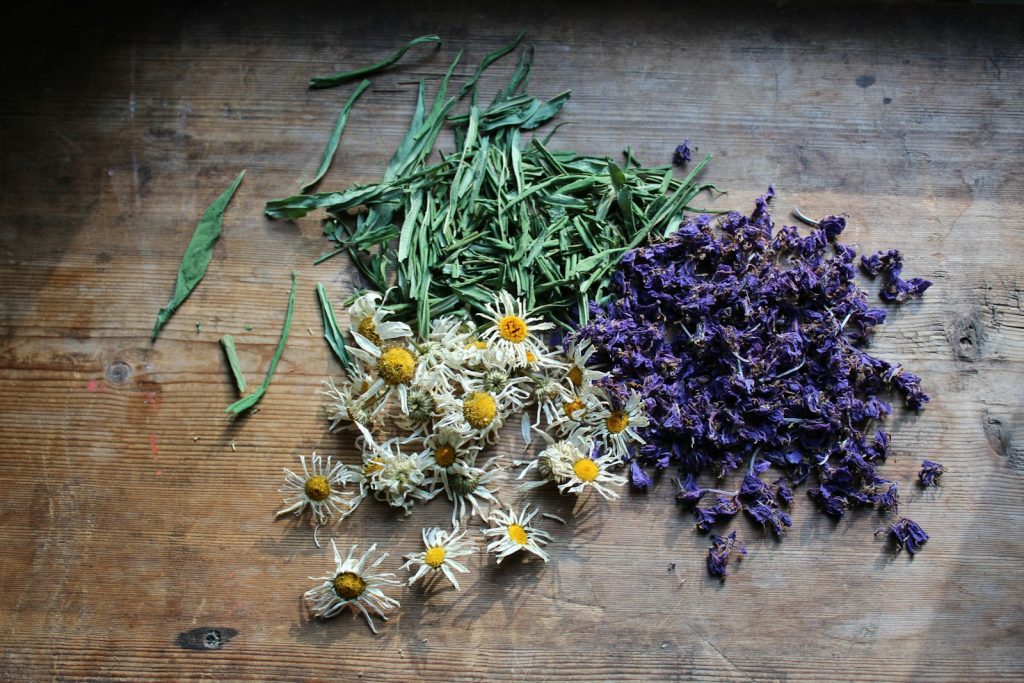
The origin of phytotherapy
Phytotherapy has been practised for thousands of years and was the main way of healing. The Babylonians recognised around 250 medicinal plants. In Egypt, both wild and cultivated plants were used to make preparations. Hippocrates, the father of medicine, described 236 plants he used in his practice. Between the 14th and 19th centuries the foundations of the pharmaceutical industry were laid, and botanical gardens were created to grow and study medicinal plants. At the end of the 19th and beginning of the 20th century the beneficial properties of vitamins were discovered, marking a new beginning in the world of medicinal plants. Phytotherapy (from the Greek “phyton” – plant and “therapy” – treatment) is a method of treatment with herbs and parts of herbs (crude drugs). In fact, the ancient Roman physician Claudius Galen was the first to propose using for healing not the plant itself, but an extract from certain parts of it.
The composition of herbs in phytotherapy
Herbs contain a huge number of beneficial substances (saponins, vitamins, tannins, essential oils, glycosides, sugars and many others). For this reason they affect several systems of the human body at once. In phytotherapy, not only the flowers and leaves are used for healing, but also the buds, roots, fruits, bark and other parts. Using herbs requires serious knowledge, as incorrect use can cause unwanted complications. Correct selection, preparation and dosage are essential.
When is phytotherapy effective?
Phytotherapy has a wide range of applications for problems in the early and middle stages of a disease. Treatment should be applied consistently and over a long enough period. Phytotherapy works best when herbs are applied in direct contact with the affected areas: for example, inhalations for respiratory problems, herbal extracts for digestive disorders, and ointments for skin and joint problems. Medicinal plants can be used fresh or dried, or as infusions, decoctions, tinctures, syrups, poultices and ointments.
Phytotherapy – storage and preparation
The first rule of phytotherapy is knowing how to store herbs. They are best kept in paper bags in the dark, so they can “breathe”. Herbs can also be kept in a glass jar, but for a shorter period. Metal utensils are not recommended for preparation, to avoid oxidation, colour changes or reduced effectiveness of the herbal tea; glass or porcelain teapots are the right choice. When no ratio is specified, add 1 tablespoon of herbs to 250 ml of hot water, or 1 teaspoon to 125 ml of boiling water. Another important principle is that prepared tea keeps for about 14 hours, and about 8 hours in the summer months. It is not recommended to drink it after this period, as it begins to spoil and may cause food poisoning. Tea is best drunk pleasantly warm or at room temperature, including when you have a cold.
Ways of using herbs in phytotherapy
The most popular way of taking the beneficial ingredients is as tea. There are two ways of preparing it: infusion and decoction.
For an infusion , the herb is placed in the vessel mentioned above, covered with the required amount of boiling water and left covered for 5–10 minutes. The liquid is then strained.
For an For a decoction, after the herbs are placed in the vessel and covered with boiling water, they are heated for 5 to 20 minutes. If the herbs are boiled for a long time, a little water should be added to make up for evaporation. The tea is strained and drunk pleasantly warm.
A tincture is an extract of the plant in water mixed with alcohol, vinegar or glycerine. Tinctures can extract chemical substances from plants without prior heating. Diluting the tincture is recommended for external use.
Pills and capsules of plant origin are convenient when a plant tastes unpleasant but contains substances that are useful for today's busy people.
There are about 500,000 plant species known so far, but unfortunately the effects of only about 6% of them have been studied. Herbs have a huge range of uses, and their composition will probably never be fully studied. Phytotherapy can be called an old science – not only people but animals too use specific plants to heal themselves. Phytotherapy is also the basis of aromatherapy, homeopathy, Bach flower therapy, cosmetology and more.
According to Baba Vanga, God has given every nation the herbs with which to heal itself on its own land.
Have a question for Dr. Hadzhieva?
Write to us or give us a call — we will be happy to help.